Updated July 2026. Saleium is now fully self-serve: you can sign up, deploy, and run everything described below yourself, starting free. This post has been refreshed to match the live platform.
Public token sales are back on the table. And most teams still face the same bad tradeoff: hand the most important moment of your launch to a third-party platform, or build fragile custom infrastructure under deadline pressure.
Saleium removes that tradeoff.
Saleium is self-serve, white-label token sale infrastructure built by ChainGPT. Web3 teams use it to run public token sales, staking, vesting, airdrops, and token creation on their own domain, under their own brand, with settlement enforced on-chain. The smart contracts are audited by CertiK, and the distribution products are live on six EVM mainnets.
→ Create a free account and deploy your first product today. No demo call required.
Public Sales Should Be Owned, Not Outsourced
A public sale is not a checkout moment. It is a high-pressure event where thousands of participants interact with your project at once. Allocation rules must hold, refunds must be predictable, and claims must be enforceable. If anything breaks, you do not just lose operational control. You lose trust.
On a shared launchpad, that trust gets built on someone else's domain, in someone else's flow, next to someone else's projects. Saleium embeds a fully white-label sale directly on your own website instead. No redirect, no fragmented journey, no dependency on someone else's platform. Your brand owns the experience. The infrastructure runs underneath.
The Big Change: You Deploy It Yourself Now
When Saleium was first introduced, getting started meant requesting a demo. That step is gone. Today the entire platform is self-serve, and the flow is the same for every product:
- Sign up free with a wallet or email, then configure your product in the dashboard: chain, schedule, accepted currencies, caps, and eligibility rules like KYC and allowlists.
- Deploy with your own wallet. You sign the transaction, so the contract instance belongs to your project.
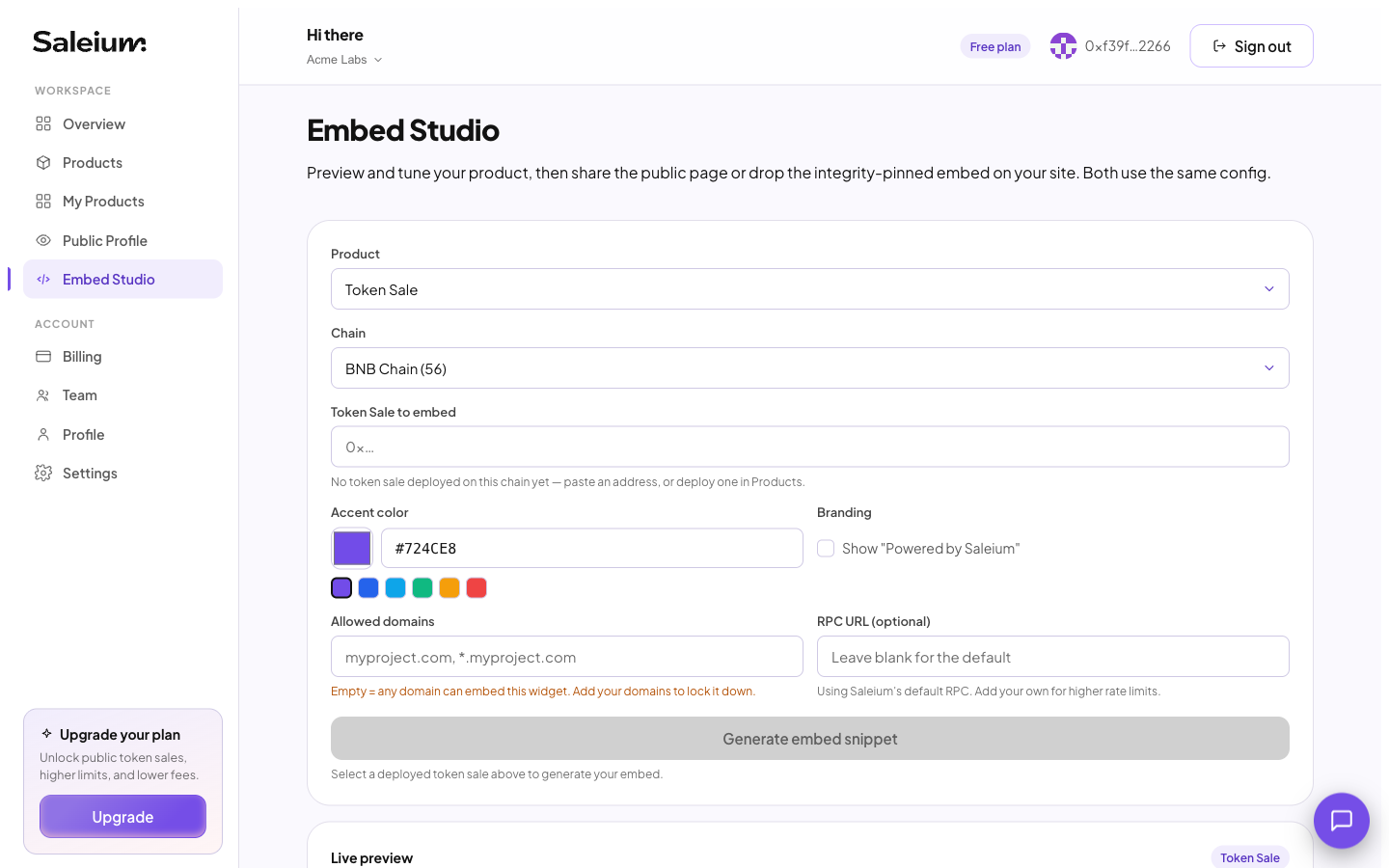
- Embed and manage. Embed Studio generates the widget snippet for your website, and the Manage panel covers funding, finalization, withdrawals, refunds, claims, and data export after launch.
That is the whole loop. For the granular walkthrough, read the guide to running a token sale on your own website.
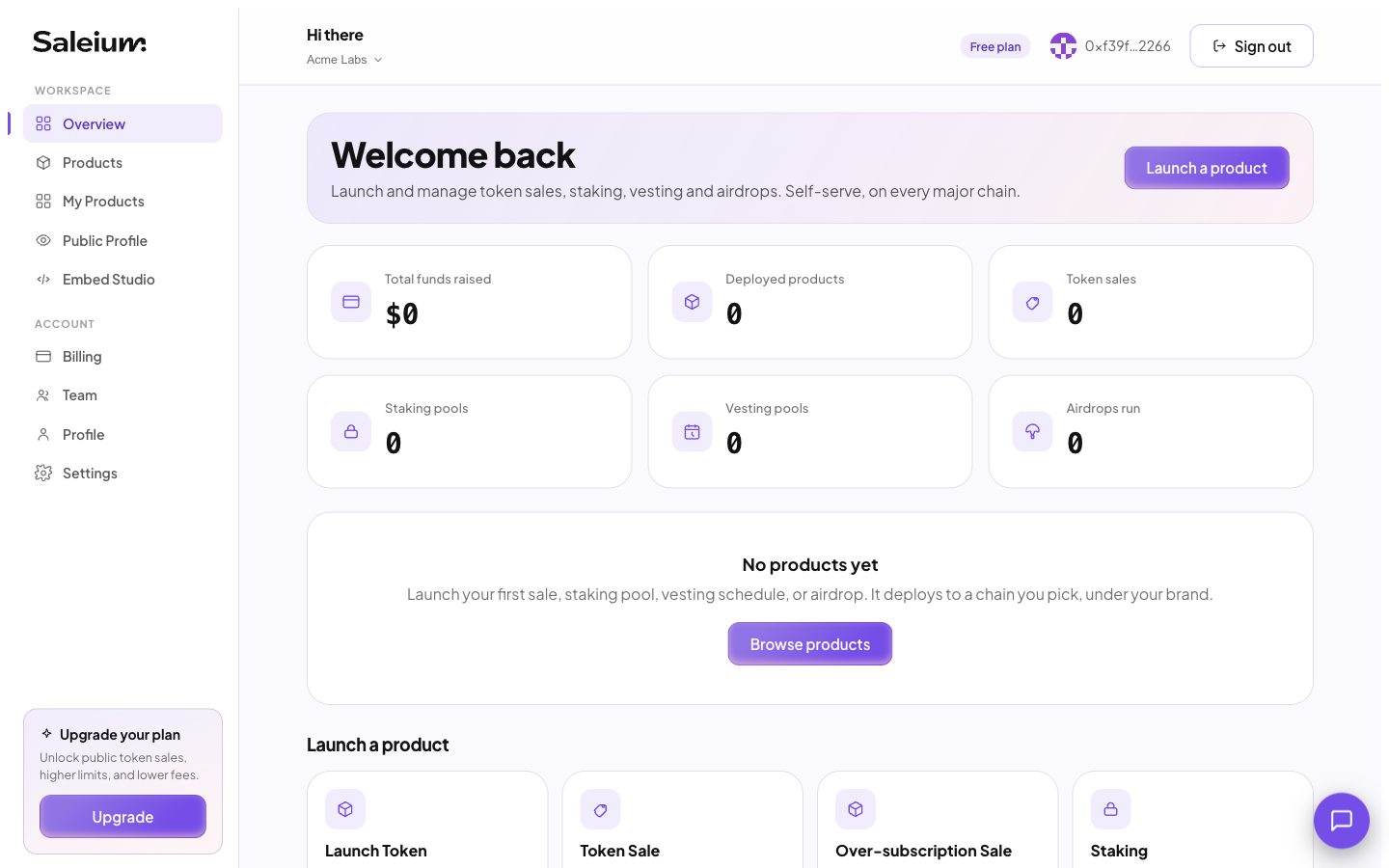
No agency build, no code. And if you ever want hands-on support, a managed Enterprise route exists. It is an option, not a prerequisite.
Five White-Label Products, One Dashboard
A launch needs more than a sale contract, so Saleium ships the full distribution stack:
- Token Sale (IDO). Public sales on your own domain: weighted and pro-rata oversubscription, on-chain settlement, claim and refund windows, and KYC and allowlist eligibility synced from the front end to the chain. The platform take is subscription-tiered, from 3% of a successful raise, as low as 0% on Enterprise.
- Staking. Branded fixed-APR or allocation pools with configurable caps, locks, and join windows, plus a funding check that verifies the reward budget before holders claim. From 0.5% of rewards, 0% on Enterprise.
- Vesting. Linear, interval, and monthly schedules, CSV bulk import, and a branded claim portal your investors can verify on-chain. Free to deploy, with a $5-per-recipient fee at allocation, capped at $1,000 per strategy.
- Airdrops. Instant batch sends or Merkle claim campaigns with a hosted claim URL. No platform fee; you pay only the network cost.
- Token Creator. Deploy a production ERC-20 with no code, live on BNB Chain today. A one-time deploy fee, lower on higher plans and waived on Business and up.
Each product is white-label and runs from the same dashboard. Full specs live at saleium.io.
How a Public Sale Runs on Saleium
Saleium treats a public sale as a structured lifecycle, not a one-off event.
1. Setup. Define the raise size, token price, accepted assets, sale window, allocation logic, eligibility rules if required, and the claim and vesting schedule. Contracts deploy with parameters locked on-chain, and the widget goes live on your domain.
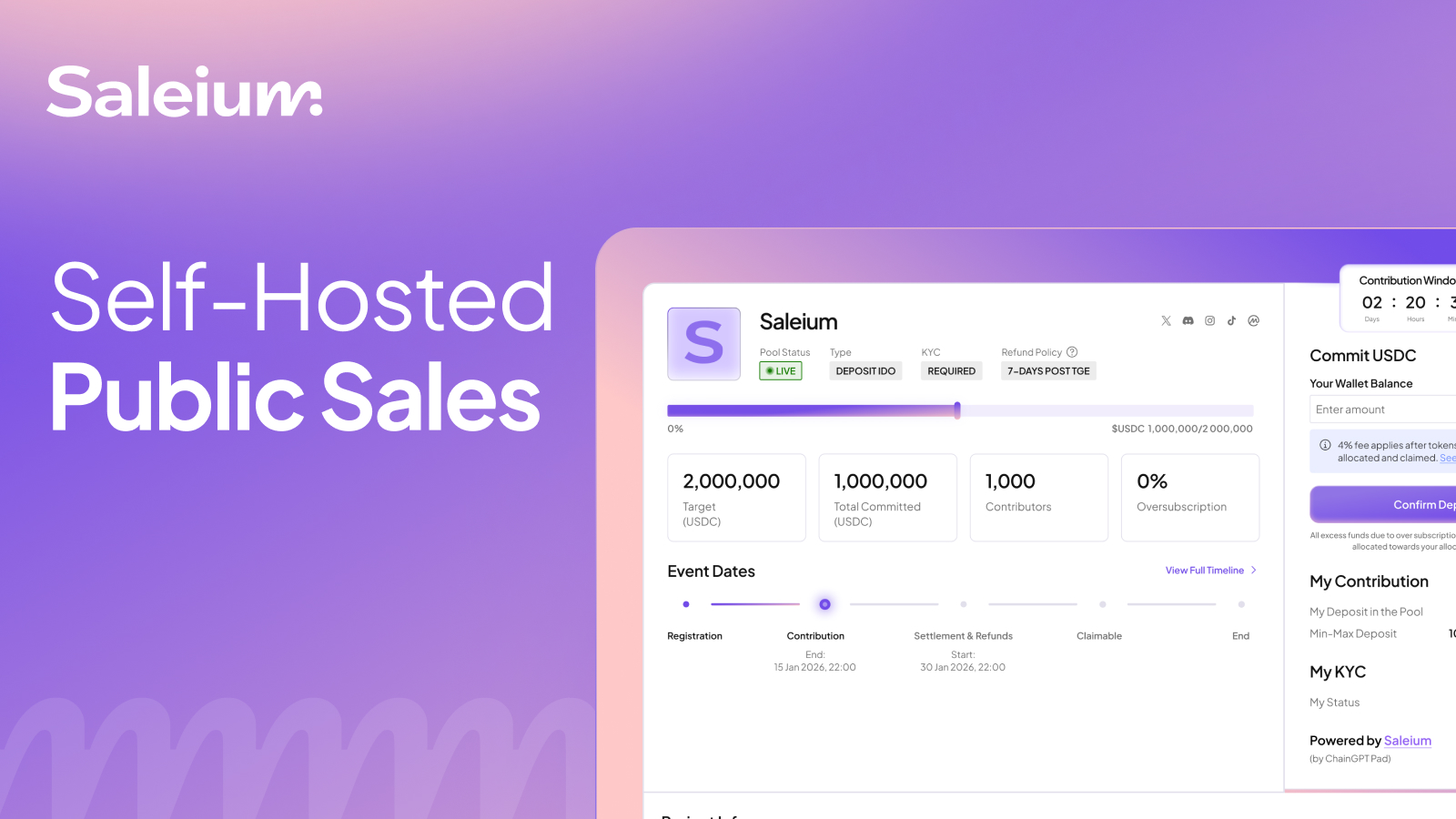
2. Commit. Participants connect wallets, pass eligibility checks where configured, and commit funds during the window. If demand exceeds supply, allocation resolves by the rules you configured, weighted or pro-rata, and excess funds remain refundable. There is no first-come scramble and no manual reconciliation.
3. Settle and distribute. Allocations finalize on-chain. Refund logic is available by default, and claims and vesting run through the same system. From commitment to claim, the process stays continuous and enforceable.
Self-Managed, Managed, or Mirrored
Teams differ in how much they want to run themselves. Saleium supports three routes on the same infrastructure:
- Self-managed (white-label). Deploy and operate everything yourself on your own domain, self-serve from $0. Maximum control, full brand ownership.
- Enterprise (managed). Keep the native on-domain experience while ChainGPT adds coordinated operational support, custom contracts, and SLAs.
- Mirror Mode. An optional add-on that also lists an eligible sale on ChainGPT Pad for extra distribution, subject to ChainGPT Pad's separate acceptance criteria, project KYB, participant KYC, and other applicable requirements.
Pricing Is Public, and It Starts Free
You do not need a quote to see what Saleium costs. Plans run from Free at $0 through Growth ($99), Plus ($249), Pro ($499), and Business ($999) per month, with Enterprise custom. Annual billing takes 33% off.
Free is a real trial, not a brochure: it includes a $1,000 demo sale, a staking pool, and your first airdrop, so you can run a real sale flow end to end before paying anything.
Platform fees drop as your plan grows. The sale take is subscription-tiered, from 3% of a successful raise down to 0% on Enterprise, and it is stamped immutably into the contract at deploy, so it cannot be raised on you after launch.
The full plan-by-plan breakdown is at saleium.io/pricing.
Security and Track Record
The Saleium smart contracts are audited by CertiK. As with any smart contract, an audit reduces risk but does not eliminate it.
Sale parameters are immutable once deployed. Domain allowlisting restricts exactly where the widget can render. Oversubscription and refund logic are enforced at the contract level, not in a spreadsheet after the fact.
And the stack is not new: it is the same infrastructure behind ChainGPT Pad, which has recorded 50+ IDOs and $20M+ in public and private round participation volume, as of July 2026. Saleium extends that backbone into a self-serve deployment model, live on BNB Chain, Polygon, Base, Arbitrum, Avalanche, and Robinhood Chain, with more EVM networks by agreement.
Frequently Asked Questions
What is Saleium?
Saleium is self-serve, white-label token infrastructure by ChainGPT. Teams use it to run public token sales, staking, vesting, airdrops, and token creation on their own domain and brand, with on-chain settlement and CertiK-audited smart contracts.
Is Saleium a launchpad?
No. A launchpad hosts your sale on its own platform and audience. Saleium gives you the infrastructure to run the sale on your own website. If you also want launchpad-style reach, Mirror Mode can list an eligible sale on ChainGPT Pad as an optional add-on, subject to ChainGPT Pad's separate acceptance criteria, project KYB, participant KYC, and other applicable requirements. If what you are searching for is a white label launchpad or a white label IDO launchpad, this is that feature set, deployed self-serve under your own brand instead of on a shared platform.
Can I really deploy everything myself?
Yes. Sales, staking pools, vesting schedules, airdrops, and tokens all deploy self-serve from the dashboard, with no code and no sales call. Your wallet signs each deployment, so the contract instance belongs to your project.
What does Saleium cost?
Plans start free and run to $999 per month before Enterprise. The sale take is subscription-tiered, from 3% of a successful raise, as low as 0% on Enterprise. Staking is from 0.5% of rewards, vesting is free to deploy with a capped per-recipient fee, and airdrops carry no platform fee.
Which chains does Saleium support?
Saleium's distribution products run on six EVM mainnets today: BNB Chain, Polygon, Base, Arbitrum, Avalanche, and Robinhood Chain. Additional EVM networks are onboarded by agreement, and Token Creator is live on BNB Chain.
Own Your Next Launch
Saleium turns public fundraising into something repeatable: a structured, enforceable flow that runs on your own domain, deployed by you, on rails you keep.
If you are planning a public token sale in the next three to six months, you can find out whether it fits by deploying it. The rails can be live today.
→ Create your free Saleium account, or read the step-by-step guide to running a token sale on your own website.
Informational content only. Saleium provides software infrastructure and related services; it does not offer, sell, or endorse tokens, and it does not provide legal, tax, financial, or investment advice. Certain features and offerings are unavailable to U.S. persons and users in restricted jurisdictions.