


Token sales rarely break the way teams expect.
The contract gets audited. The frontend gets stress-tested. The marketing gets aligned. Then the sale opens, and within minutes, the failures that surface are the ones nobody modeled. They happen at the seams between systems, not inside any single one.
For teams running self-hosted sales, those seams are where the real risk lives. The infrastructure either holds together as a unit, or it shatters as a unit.
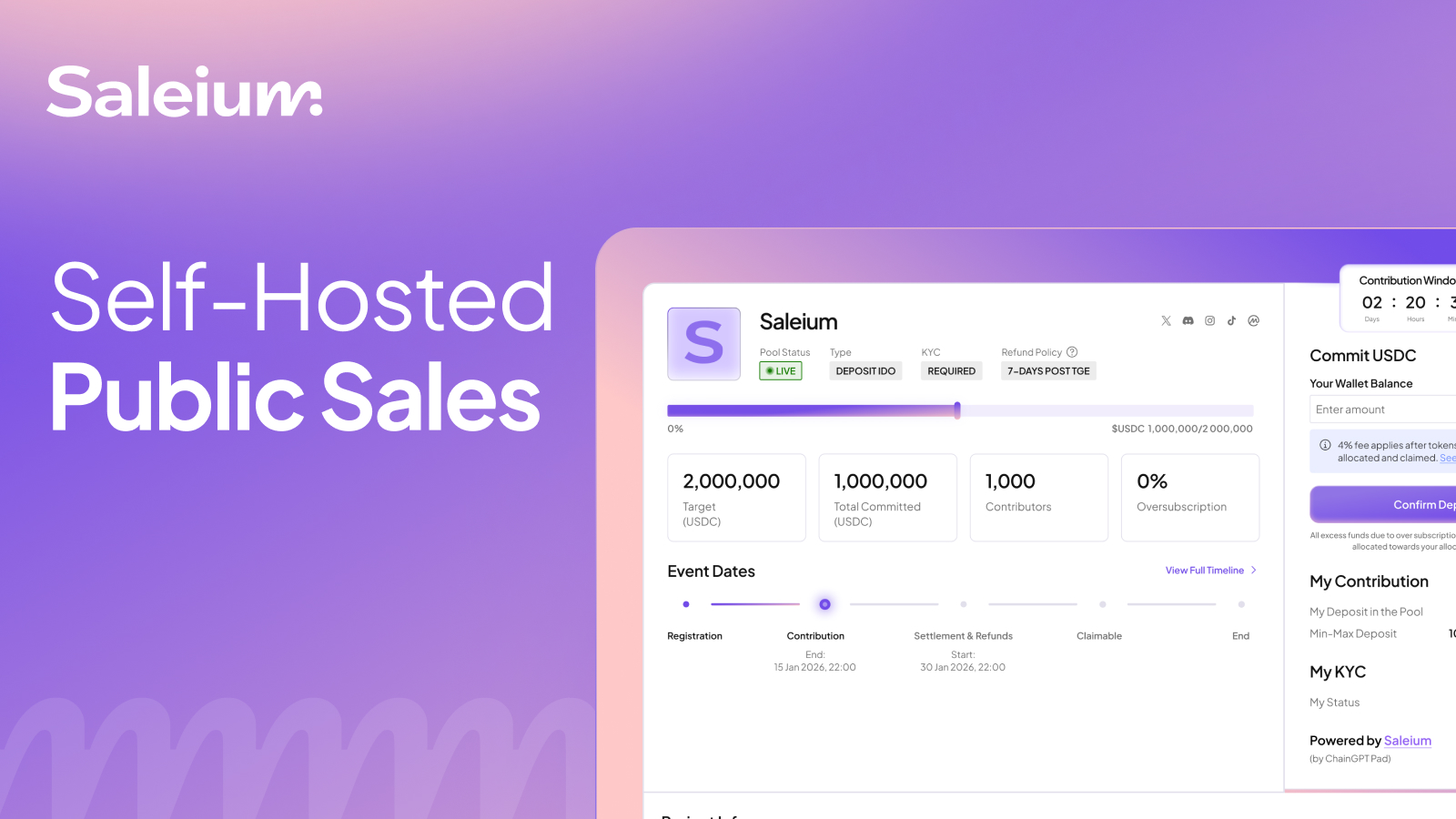
Saleium is built to absorb that risk. It gives Web3 teams a full-cycle token sale system that runs natively on their own domain, with on-chain enforcement across commit, finalization, refunds, and claims, designed specifically for the failure modes that take down public sales.
→ Book a demo with the Saleium team to see how it works.
Allocation Logic Has to Be On-Chain
Most teams plan for an undersubscribed sale. The ones that should be worried are the ones that succeed.
Oversubscription is the first failure mode in a high-demand launch. When commits exceed the cap, the sale needs deterministic, on-chain logic to resolve allocations pro-rata, refund excess funds, and finalize the result without manual intervention. Anything less turns success into a multi-day reconciliation problem, and a community that watches their funds sit in limbo while the team figures out what to do next.
Saleium handles this at the contract level. Allocations resolve pro-rata, excess funds are refundable by default, and finalization is part of the same system as the commit phase, not a separate process bolted on afterward.
Refunds Spiral Quickly
The second thing that breaks is what happens to the money that didn't make it in.
If refunds depend on a manual process, with operations triggering transfers, finance reconciling against a spreadsheet, and support fielding tickets from participants who don't see their funds back, a one-day sale becomes a three-week customer service problem. And every hour of delay erodes the trust the sale was supposed to build.
Saleium runs refunds through the same on-chain flow as the rest of the sale. Participants who get refunded see it happen, see it on-chain, and don't need to file a ticket to confirm it. The system closes the loop instead of leaving it open for ops to chase down later.
Vesting Breaks Weeks Later
The hardest breakages don't show up on launch day. They show up in month three, when the first cliff hits and the off-chain vesting script that someone wrote for the launch has not been maintained.
Vesting calculated by a cron job is fragile. Cliffs that are not enforced at the contract level get disputed. Claims that route through a custom backend become attack surface. None of this is exotic. It is just what happens when vesting is treated as a separate problem from the sale.
Saleium's vesting runs through the same infrastructure as the sale itself, with schedules enforced on-chain. The team that ran the sale does not need to keep a vesting script alive for eighteen months to honor it.

Community Channels Collapse Under Demand
While the on-chain sale is happening, an off-chain sale is happening in Telegram and Discord. Within minutes of launch, scam accounts impersonate the team, phishing links get pinned by compromised mods, and support tickets pile up faster than humans can answer them.
The participants who needed to find an authoritative answer in those first thirty minutes, about eligibility, about claims, about whether their transaction went through, find chaos instead. The sale that worked perfectly on-chain still ends with a community that doesn't trust it.
Running the sale on your own domain, inside a flow participants never have to leave, removes the largest source of confusion before the sale even opens.
Closing Thought
Public token sales fail in specific, predictable ways. Oversubscription mishandled. Refunds delayed. Vesting unenforced. Community channels overrun. Each of these is solvable in isolation. What kills launches is that they hit together, on the same day, against teams that built each piece separately.
Saleium is built as the integrated layer underneath all of it. Self-hosted, on-chain, audited by CertiK, and battle-tested across $20M+ raised and 35,000+ KYC-verified participants through ChainGPT Pad.
Request a demo today!






.png)


